





Conventions for U-value calculations (BR443 2e 2019)
BRE (Building Research Establishment) is an independent, research-based consultancy, testing and training organisation, operating in the built environment and associated industries.
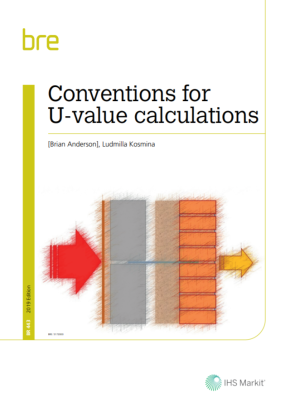
The 2019 edition of Conventions for U-value calculations (BR443 2e 2019), was published by BRE in November 2020. It was written by Ludmilla Kosmina, and dedicated to Brian Anderson, the author of the 2002 and 2006 editions, who died unexpectedly in 2016.
Updates to the 2006 edition primarily reflect changes in British, European, and international standards, referring to BS EN ISO standards published from 2017 onwards.
The report is concerned with the calculated U-values of new building elements, including walls, roofs, floors, windows and doors. Guidance is provided for: thermal conductivity of materials; issues that commonly arise when undertaking U-value calculations; and types of construction element, identifying which of the issues apply to which construction type. It does not reproduce the details of the calculation methods, for which the reader is referred to the relevant British Standards and other sources.
For constructions that cannot be handled by the basic calculation methods, the U-value can be calculated by numerical analysis or measured by a hot box method. The report gives guidance on the appropriate standards used for establishing the measured values of thermal transmittance (U-value) and the appropriate standards used for establishing the thermal resistance (R-value) of a construction layer by numerical calculation.
The contents of the 80-page report are:
- Introduction.
- U-value calculation: Simplified methods and numerical methods.
- Details of U-value calculations.
- Elements adjacent to an unheated space.
- Expression of results and areas to which U-values apply.
- U-values for walls.
- U-values for roofs.
- U-values for floors.
- U-values for basements and swimming pools.
- U-values for windows, roof windows and rooflights.
- Curtain walls.
- Dynamic transparent building elements.
- U-values for doors.
- U-values of existing (old) walls, roofs, and floors in dwellings.
- Appendix A: Glossary/definitions.
- Appendix B: U-values of uninsulated floors.
- Appendix C: Example of calculating U-value for elements.
- References and further reading.
The report is available from the BRE Bookshop at: https://www.brebookshop.com/details.jsp?id=328041
See also: Conventions for U-value calculations (2006 edition) BR 443.
[edit] Related articles on Designing Buildings
- Approved document L.
- BRE articles on Designing Buildings Wiki.
- Building regulations.
- Building Research Establishment.
- Conventions for calculating linear thermal transmittance and temperature factors.
- Conventions for U-value calculations (2006 edition) BR 443.
- Insulation.
- Kappa value.
- Simplified Building Energy Model.
- Standard Assessment Procedure.
- Thermal bridge.
- Thermal mass.
- U value.
- U-value conventions in practice: Worked examples using BR 443.
- What do design professionals need to know about U-value calculation conventions?
Featured articles
Check out some of the best features and news from Designing Buildings as well as key stories from around the web.

Government approach could undermine delivery and regeneration.
World's first mass timber data centre.

The overlooked environmental aspect of data centre development.
Introduction to radon awareness

New technical information sheet published by CIOB.

Updated supplier guide can help electrical contractors engage with NHP.

CIAT confirm the winners of the 2026 architectural technology awards.

Government launches a one stop shop for flood preparedness.

Sir Edwin Lutyens: Britain's greatest architect? Book review.

CIOB publishes free template to help assess and manage risks.
ECA's reflections on Party Conference season

Burnham wants to be confident of winning before asking for a fresh mandate.
New Chief Construction and Scientific Adviser

Sergio Cavalaro, Professor of Infrastructure Systems at Loughborough University.
Building safety levy for England

CIAT publish estimator tool for members.

Water sector faces a growing crisis that could slow the delivery of vital infrastructure.